Preflop is the first betting round in Texas Hold’em: it starts once everyone has their two hole cards and ends before the three-card flop is dealt. Preflop strategy is how you decide, from those two cards plus your seat and the action in front of you, whether to fold, call or raise.
How the preflop round works
The small blind and big blind post, and everyone gets two cards. Action starts with the player to the left of the big blind (under the gun) and goes clockwise. The big blind already counts as a bet, so nobody can check except the big blind, and only if no one raised. You fold, call the big blind (a “limp”), or raise.
You know very little at this point. There is no board, so you’re deciding from your two cards, where you sit, how deep the stacks are and what the players before you did. That’s why good preflop habits matter so much. Every hand you play badly here turns into a hard decision on the flop, turn and river. If you need the full hand order first, start with how to play Texas Hold’em.
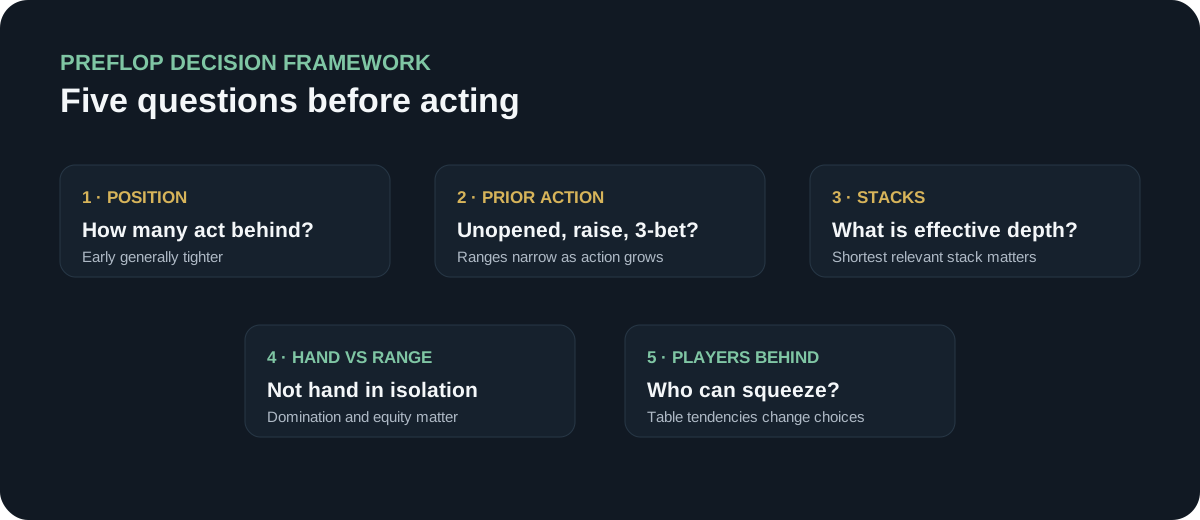
Five questions before you put a chip in
- Where am I sitting? Early seats have more players left to act behind them and should play fewer hands.
- What happened before me? An unopened pot, a single raise, a raise with two callers and a 3-bet are four different spots.
- How deep are the effective stacks? The shorter stack between you and your opponent caps what you can win or lose.
- How does my hand do against the hands that raise or call here? “It can make a pair” is not a plan.
- Who is still to act? A player who calls everything, a frequent re-raiser or a short stack behind you changes the price of getting in.
Positions at a nine-handed live table
Toronto casino cash games usually run 8- or 9-handed, not 6-max like many online games. Use this map as a starting point, then adjust to the actual number of players.
| Seat | Name | What it means preflop |
|---|---|---|
| First to act after the blinds | Under the gun (UTG) | The most players behind you. Play your tightest range. |
| Next two seats | UTG+1, UTG+2 (early) | Still lots of players to act. Don’t play these like the button. |
| Middle seats | Lojack, hijack | A bit wider than UTG, but not a steal seat yet. |
| Two to the right of the button | Cutoff | The first real stealing seat if it folds to you. |
| Dealer button | Button | Acts last on every street after the flop. Your widest range. |
| The two forced bets | Small blind, big blind | Out of position after the flop. Defend based on price and range, not because you “already put money in”. |
The full seat map is on poker positions.
First in: raise or fold
When nobody has entered the pot, raising or folding is a cleaner default than limping. A raise tells a consistent story, charges the blinds to play and gives you a chance to win the pot right there.
A simple starting range for a nine-handed live game, if it folds to you:
- Under the gun and early seats: pairs 77 and up, A♠Q♦ and better, suited broadway like K♥Q♥ and A♣J♣.
- Middle seats: add smaller pairs, A-J and A-10 suited, K-J suited, and suited connectors like 9♠8♠.
- Cutoff and button: add most pairs, suited aces, K-10 and Q-J offsuit, and more suited connectors and one-gappers.
That is a baseline, not a law. Preflop ranges explains how charts are built and where they stop being useful, and open raising goes seat by seat.
How much to raise
Live games play with bigger raises than online. At $1/$3, an open of $10 to $15 is common, and you add about one big blind ($3) for every player who limped in front of you. If two players limp and you have A♦K♠ in the hijack, raise to about $18 rather than $12. Keep your size the same with your strong hands and your weaker ones so it doesn’t give your hand away.
Limpers in front of you
Live $1/$3 and $2/$5 pots in Toronto rooms are often limped and multi-way. Joining the limp with a hand like K♣10♦ puts you in a five-way pot with a hand that rarely wins one. With position and a decent hand, an isolation raise against a weak limper is usually better. With a small pair or suited connector on the button behind three limpers, a call can be fine because you’ll get paid when you hit.
Facing a raise
Once someone has opened, your options are fold, call or 3-bet (re-raise). Match your hand to the raiser’s seat:
- An early-position raise is usually stronger than a button raise. Calling it with a hand like A♣9♦ is how you flop top pair and still lose your stack to A-K.
- A late-position raise can be wider. Re-raising some of your hands is often better than calling out of position.
- A raise plus two callers is a different pot from heads-up. Small pairs and suited connectors like it because the payoff when they hit is bigger. Dominated high cards get worse.
Example: at $1/$3, UTG raises to $15 and you hold K♠J♦ in the cutoff. Fold. The hands that raise from under the gun include A-K, K-Q, A-J and big pairs, and you’re in bad shape against all of them. Same hand, but it’s the button who raises to $12 and you’re in the big blind: calling is reasonable, because the button’s range is much wider and you’re getting a better price.
3-betting and calling preflop cover these two branches in detail.
Avoid the domination trap
Hands such as K♥9♠ or A♣7♦ can flop top pair and still be behind K♦Q♣ or A♠J♣. When you both pair the same card, the better kicker wins, and you’ll often pay off three streets finding that out. If your hand’s main hope is pairing a card that also pairs a better kicker, folding is usually the right preflop play.
Stack depth changes the same two cards
The effective stack is the shortest stack that can go into the pot. At about 100 big blinds ($300 at $1/$3), suited connectors and small pairs have room to win a big pot when they hit. At 25 to 40 big blinds, those same hands lose most of that payoff, and high cards and all-in math matter more. Check the room’s posted buy-in range on the stakes matrix before you treat an online 100 big-blind chart as a live rule, and see cash-game buy-ins for how buy-ins turn into stack depth.
Live Toronto games
In a Great Canadian or Pickering $1/$3 game you’ll see more limps, more multi-way flops and more raises that don’t make sense than in a 6-max online pool. The five questions still apply. What changes is how many hands other people play. Tighten up from early seats, punish obvious limps when you have position, and don’t run a 6-max “open 40% from the cutoff” script at a nine-handed live table you haven’t watched for at least an orbit.
FAQ
What is preflop in poker?
Preflop is the first betting round in Texas Hold’em, after each player gets two hole cards and before the three-card flop. Action starts left of the big blind, and players fold, call or raise. Only the big blind can check, and only if nobody raised.
What is pre flop strategy?
It is how you decide whether to play a hand, and how, before any community cards are out. A good preflop strategy looks at five things: your position, the action before you, the effective stacks, how your hand does against the likely opposing hands, and who is left to act.
Is preflop the same as pre-flop or pre flop?
Yes. Preflop, pre-flop and pre flop all mean the same betting round. Players and dealers use all three spellings.
Should beginners limp preflop?
Not as a habit. When the pot is unopened, raise or fold. Limping every playable hand leads to multi-way flops where you rarely know where you stand. Calling behind other limpers with a small pair or suited connector in late position is a separate, reasonable play.
Does live casino preflop differ from online?
Yes. Live Toronto games are usually 8- or 9-handed, slower, more multi-way and use bigger raise sizes. Online 6-max charts are useful for study, but they are not a seat map for Great Canadian or Pickering.
Related lessons
Open raising
Which hands to raise first in from each seat.
Preflop3-betting
When to re-raise, and how big.
PreflopCalling preflop
When the price and position make a call sensible.
BasicsPoker positions
Why acting last is worth so much.
By the TorontoPoker.org editorial team · Updated September 2026 · 19+ · Play responsibly